
THE CULTBRAND PROCESS EXPLAINED
The CultBrand Process is how you build a brand based on devotion rather than loyalty
There’s a profound difference between those loyalty and devotion. Loyal customers come back when it’s convenient. Devoted ones come back regardless — and bring people with them. The CultBrand process is the methodology for building the second kind of brand.
What is a cult brand?
A cult brand is a brand that has given its community something more valuable than a product: an identity. Members of a cult brand community don’t just buy from the brand. They identify with it. They use it to signal who they are to the world and who they are to themselves.
You see it with Apple users who wouldn’t consider switching. CrossFit athletes who introduce themselves by their box before they introduce themselves by their name. Bad Boy Running members who tattoo the brand because being a BBR runner is, genuinely, part of who they are.
The brands that achieve this aren’t the ones with the biggest budgets, the most charismatic founders, or the most aggressive growth strategies. They’re the ones that got the underlying mechanics right.
A cult brand is not built around a personality. It’s built around an identity that belongs to the community, not the founder
What the CultBrand process is
(and what it isn't)
The CultBrand process is a structured methodology for building brand devotion from the ground up. It’s based on the Cult Commandments, the principles distilled from studying the mechanics that every devoted brand shares, regardless of sector, size, or history.
It is not the same as the cult brand advice that’s been circulating in marketing for years.
That version tends to assume you need a founder with unusual personal magnetism, a first-mover advantage, or a product category where obsession is culturally expected - running shoes, coffee, fitness.
The CultBrand process works specifically because it removes that assumption. Devotion comes from community identity and community identity can be deliberately built.
Bad Boy Running proved it: two hosts nobody had heard of, a podcast in a category with thousands of competitors, and a community that grew into something people tattooed onto their bodies.
The methodology is what made that possible. Not luck. Not charisma. The process.
INTRODUCING THE CULTBRAND PROCESS
The CultBrand Process has been carefully developed and engineered based on Jody's experience and having worked with hundreds of businesses, from small one-person consultancies looking to grow to large fintech brands with global ambitions.
This approach has been tested and applied successfully in businesses across the spectrum, from high-flying technology brands that want to make their apps stickier and their followers more devoted, to legal services firms that break the mould.
This has worked for coaches, training platforms, service businesses – in fact, any business that attracts an audience.
Many believed they needed thousands of followers, but they realised that even a small but devoted following was enough to seriously kick-start their business.
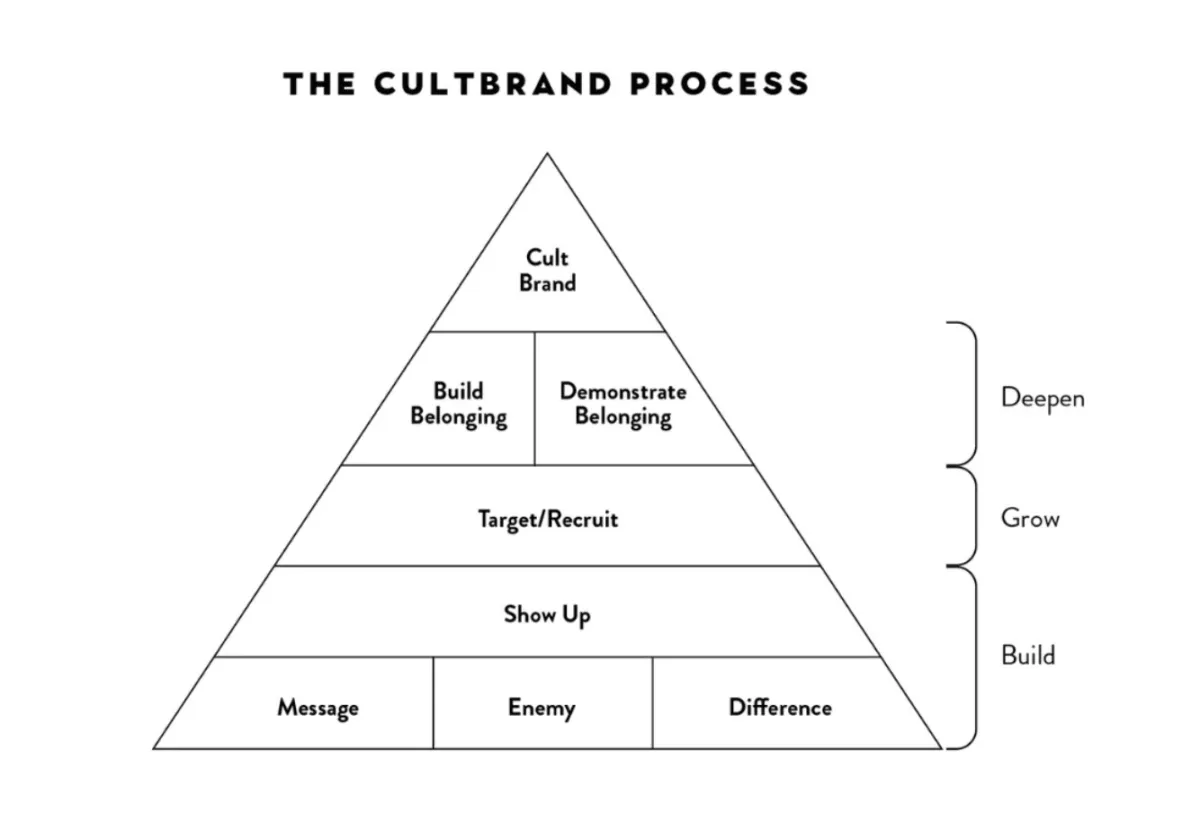
This model was designed to be followed in order, and every part is critical to your end mission to start and grow a cult.
Brought together, seven steps will make your competition irrelevant, kick-start sales and make your brand magnetic to the right kind of people who love what you do.
When you follow the CultBrand model in the right order and with the right level of application, expect to see major changes in how you lead, how your brand is perceived and how you build your relationship with your followers, fans and customers.
THE CULT COMMANDMENTS
The seven steps of the CultBrand Process are expressed through the 7 Cult Commandments. Each represent an action to take as well as the order in which to take action.
CULT COMMANDMENT #1
Develop a Polarising Message
CULT COMMANDMENT #2
Pick an Enemy (or two)
Cult brands aren’t for everyone and they don’t hide the fact. They define not just who they’re for, but who they’re against. A point of view without opposition isn’t a point of view. The enemy is not always a competitor. It’s a belief, a behaviour, or a way of doing things that your community has collectively rejected.
CULT COMMANDMENT #3
Be Different. And celebrate it.
Products can be copied. Worlds cannot. Cult brands create a sense of place - physical, digital, or psychological - that feel distinct from the world outside. The brand becomes a place you belong to, not just a thing you buy from.
CULT COMMANDMENT #4
Broadcast consistently.
CULT COMMANDMENT #5
Target outliers and misfits.
CULT COMMANDMENT #6
Build belonging.
CULT COMMANDMENT #7
Give followers opportunities to demonstrate belonging.
Passive audiences are not communities. Cult brands require something of their members, to make some kind of effort, contribution or by participating. The requirement is what creates investment. Investment creates identity. Identity creates devotion.
These seven commandments are the foundation of the process. The full CultBrand process is explained in the book, How To Start A Cult.
The diagnostic implementation framework, and community mechanics are covered in greater depth inside CultBrand Academy.
How is this different from other cult brand frameworks?
The short answer: most cult brand frameworks are built around observation, not mechanics. They describe what cult brands look like from the outside, such as the rituals, the aesthetics, the fan behaviour. The CultBrand process is built around what actually creates those outcomes.
Most importantly, the CultBrand process is specifically designed to work without a charismatic founder at the centre. Every other cult brand framework - explicitly or implicitly - assumes that the brand’s devotion flows from a magnetic individual. Jobs. Musk. Bezos.
The CultBrand process is built on the opposite premise. Devotion flows from community identity. The founder is a mechanism for establishing that identity but is not necessarily the source of it.
When you build it correctly, the community sustains itself regardless of whether the founder remains visible, famous, or even involved.
A cult brand is not built around a personality. It’s built around an identity that belongs to the community, not the founder
Who the CultBrand process is for
The methodology works for any brand where community is either the product or the strategic advantage - which, when you understand how devotion compounds, is most of them.
It works most effectively for:
Founder-led businesses where the brand needs to become bigger than the founder
Professional service businesses where relationships are the product and devotion drives retention and referrals
Brands in competitive markets where differentiation through product alone is unsustainable
Community-first businesses - podcasts, platforms, memberships - where the community is the value proposition
Brands being built by people who aren’t famous, don’t want to be, and need their methodology to work without personal charisma
A cult brand is not built around a personality. It’s built around an identity that belongs to the community, not the founder
How to get started
There are three ways to engage with the CultBrand process,
depending on where you are and what you need.

Book
Read How To Start A Cult. Covers the full methodology, the Cult Commandments in detail, and the diagnostic process for identifying what your brand is currently missing.

Training
Join one of the CultBrand courses or programs, such as CultBrand Academy. Our courses builds the methodology into structured implementation plans, incorporating world-class training, support and and the community of rebels.

Consulting
Work with Jody directly. For brands that want the methodology applied by the person who created it.
CONTACT
NAVIGATION
READY TO BUILD A CULT FOLLOWING?
©2026 Raynsford Education Ltd. All Rights Reserved | Privacy Policy